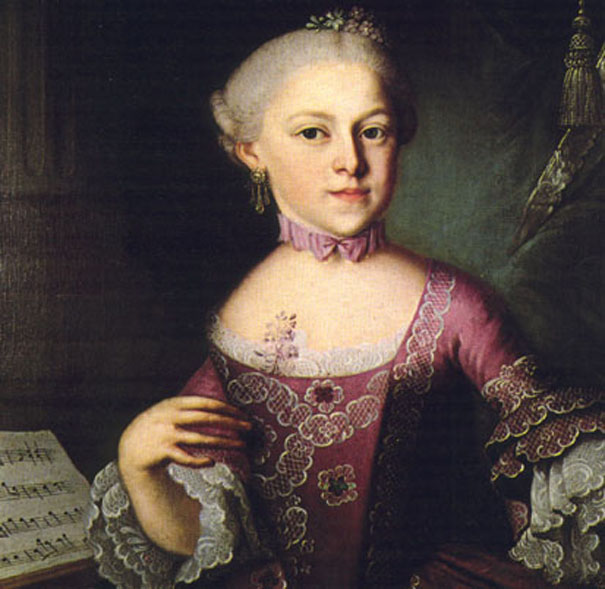

Have you ever heard a name so grand and filled with intrigue that it stops you in your tracks? Meet Theresia Constanzia Adelheid Friedericke Maria Anna Mozart. Quite a mouthful, right? But let me tell you, this isn’t just any ordinary name—it’s a regal roll call that pays tribute to a family enshrined in musical history. Born to one of the most renowned composers in the world, Theresia’s name is a kaleidoscope of ancestral nods, each part honoring Mozart family members who came before her. It’s like a family tree rolled into a name!
Theresia made her grand entrance into the world on December 27, 1787, in the ever-enchanting city of Vienna, Austria. This is where her story began, but sadly it wasn’t long enough to unfold fully. As the first daughter in a household of sons, her birth was a significant event for the Mozart family. Imagine the joy and excitement permeating through the house, Stadt 281, known as “Zum Mohren.” The very walls of that home, burgeoning with musical genius, must have vibrated with something special when Theresia arrived.
The Short Life of Theresia Mozart
Alright, here’s the thing—you might think life in 1787 for the Mozart clan would be a fascinating mix of sheet music and spectacular symphonies. And you’d be right, to an extent. But it was also a time of trials, and young Theresia’s story is a testament to that. She was born in a vibrant city, Vienna, a hub of culture and creativity, the perfect backdrop for the daughter of Wolfgang Amadeus Mozart and Constanze Mozart. Her arrival was like adding a delicate new note to the Mozart symphony of life!
Now, being the first daughter after a string of sons was a big deal for the Mozarts. But life back then wasn’t kind to the fragile and the young. Families expected heartbreak, and the loss of a child wasn’t uncommon. Theresia lived a tragically short life—only a little over six months—but her birth was undoubtedly a joyous occasion. Imagine the pride Wolfgang and Constanze felt while introducing their little girl to the world, envisioning her future while silently humming a lullaby composed just for her.
Tragic Ending in a Turbulent Era
June 29, 1788, would become a somber date etched in the annals of Mozart family history. Theresia’s short life came to an untimely end, likely due to intestinal issues—an ailment all too common during a time when infant mortality rates were heart-wrenchingly high. Can you even begin to fathom the emotional blow this would have delivered to the Mozarts? It wasn’t just the loss of a child but the end of countless dreams and hopes attached to her promising future.
In a world emerging through both enlightenment and turmoil, the Mozarts had to navigate all of life’s ups and downs. Theresia’s death was not just another family tragedy—it reflected the frailness of human life at the time. A simple ailment could spiral into something much worse, leaving emptiness in the halls where laughter and joy should have echoed.
Broader Context of Mozart’s Personal Life
Here’s where things get even more heart-wrenching. The passing of Theresia wasn’t an isolated event. Just a few years prior, in 1783, Wolfgang and Constanze had already faced the death of another child, Raimund Leopold. It’s a sobering thought, isn’t it? We often picture or even romanticize historical figures like Wolfgang Amadeus Mozart living larger-than-life existences, but this reminds us of his very human vulnerability, especially in times of loss.
Yet, amidst all this grief, Mozart showed an astonishing level of resilience. Can you imagine composing some of the most iconic symphonies while grappling with such sorrow? It seems Mozart used his art as an emotional outlet, channeling his melancholy and hope into his music. This period saw him creating his final three symphonies—a testament to how intertwined his personal life was with his creative process.
Understanding the Mozart Family’s Legacy
Now, let’s talk about legacy—the cultural impact and traditional weight carried by family naming conventions. Theresia Constanzia Adelheid Friedericke Maria Anna was more than just a flurry of beautiful names; every name portion had a backstory, a layer of family history. “Maria Anna” was a loving tribute to Mozart’s sister Nannerl, one of his closest confidantes and earliest musical inspirations.
Sadly, no other detailed records or descendants exist to tell us more about Theresia’s brief life. She’s like a shooting star; a flash of brilliance gone too soon, but her name is ensconced in the rich history of one of the greatest musical dynasties. It reminds us, though we’ve got no concrete stories or anecdotes, her brief existence resonated with timeless history.
Concluding Thoughts
So, what’s our big takeaway here? Theresia’s fleeting existence, while heartbreaking, paints a more intimate picture of the Mozarts that we don’t often see. Beyond the scores and bright lights of musical genius, their lives were punctuated with profound personal struggles. Wolfgang Amadeus Mozart, remembered as a maestro and a trailblazer, lived in a world that was kind of like a Mozart symphony—full of crescendos and diminuendos, surging with joy and ebbing with grief.
In reflecting on Theresia’s blink-of-an-eye existence, we’re not just acknowledging another Mozart, but also celebrating the resilience and depth of emotional experience that shaped the soundscapes we still enjoy today. Her brief presence created emotional ripples among the Mozarts, who shaped a legacy of triumph over tribulation.
For more fascinating insights and cultural gems, feel free to explore further here.