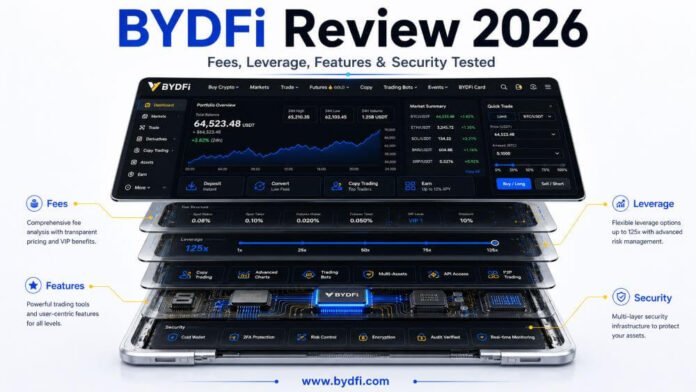

On 26 August 2025, Newcastle United announced a multi-year deal with a crypto exchange most casual fans had never heard of. Six months later, the EU’s MiCA framework forced several smaller platforms to halt European operations entirely. One exchange landed a Premier League shirt sponsorship; others scrambled just to stay compliant. That contrast raises a fair question: does the platform behind the Newcastle partnership actually hold up under scrutiny — fees, leverage, security, the works?
BYDFi has been running since 2020. Six years in, it reports over 1,000,000 registered users and operates across numerous markets globally. The Newcastle United deal, announced 26 August 2025, made it the club’s Official Crypto Exchange Partner — a Premier League sponsorship that puts the brand in front of millions who’ve never opened a trading app. What follows is a hands-on walkthrough of the five things that actually matter when picking an exchange.
What You’ll Learn
By the end of this piece, you’ll know:
- How to register and start trading in under three minutes with BYDFi’s no-KYC onboarding process.
- Exactly what spot, futures, and TradFi fees cost at every VIP tier.
- Which leverage and margin modes are available, and how to test them without risking a cent.
- How copy trading, bots, and the Bot Marketplace work in practice.
- Whether the platform’s Proof of Reserves and security setup meet a reasonable standard.
Each section includes steps you can follow along with right now.
Step 1: Registration and Onboarding
You can start spot trading with just an email address. No passport photo, no selfie, no waiting. That said, KYC requirements are tightening globally, and optional identity verification unlocks higher withdrawal limits plus features like P2P trading. Make sure you’re compliant with whatever rules apply where you live.
Here’s the practical sequence:
- Head to the platform on desktop or grab the app (iOS, Android, and APK — available in 22 languages).
- Enter an email and set a password. Sign-up took under 90 seconds in our test.
- Enable two-factor authentication immediately. The exchange enforces 2FA, but don’t wait — do it before you deposit anything.
While BYDFi supports no-KYC trading for basic users, completing KYC unlocks higher withdrawal limits and access to P2P trading. P2P launched in 2026 as another fiat-to-crypto on-ramp, so if buying crypto directly from other users appeals to you, verification is a must.
Funding your account: The fiat gateway supports 100+ currencies through four methods — One-Click Buy, Bank Transfer, Credit/Debit Card, and P2P Trading — via third-party providers like Banxa, Paybis, Transak, and Mercuryo, among others.
Before you put real money in, try the demo. The platform hands you a 50,000 USDT demo balance with full feature parity — both USDT-M and COIN-M perpetual contracts, leverage up to 200x. It mirrors live trading closely enough to test order types and liquidation levels without any financial exposure.
The platform’s no-KYC option makes onboarding significantly faster than exchanges that require mandatory identity verification before trading. But let’s be realistic: completing KYC is increasingly standard, and it’ll likely become mandatory as regulations catch up.
Step 2: Fee Structure — Spot, Futures, and TradFi
Fees are where most exchange reviews get hand-wavy. Here are the exact numbers.
| Category | Maker Fee | Taker Fee | Notes |
| Spot (all VIP levels) | 0.1% | 0.1% | Flat rate, no VIP discount |
| Futures (VIP 0) | 0.02% | 0.06% | Base tier |
| Futures (VIP 6) | 0.008% | 0.032% | Up to 60% discount |
| TradFi (Stocks/Forex/Commodities) | 0% | 0% | Settled in USDT |
Spot fees sit at a flat 0.1% / 0.1% regardless of VIP level. Nothing remarkable there. Futures are where it gets interesting. A 0.02% maker fee at VIP 0 is already competitive against most mid-tier exchanges. Work your way through the 7-tier VIP program (VIP 0–6) — based on 30-day futures volume or asset balance — and you’re looking at 0.008% maker / 0.032% taker. Higher tiers also unlock express withdrawals and a dedicated account manager.
Withdrawal limits start at 500,000 USDT per 24 hours for VIP 0 users, scaling to 2,000,000 USDT at VIP 6. For most retail traders, the base tier won’t be a bottleneck.
The TradFi offering is a genuine differentiator. The platform provides tokenized versions of select US stocks, forex pairs, and commodities at zero stated trading fees, settled in USDT. Worth noting: tokenized securities carry different regulatory implications depending on where you are, spreads may still eat into your returns, and the feature might not be available in all regions. Still, most crypto-native platforms don’t offer anything like it — and for traders who want traditional market exposure without leaving the crypto ecosystem, it’s a compelling bridge.
As Investopedia explains, fee structures vary widely across exchanges, and the maker-taker model used here is industry standard.
Step 3: Leverage and Perpetual Futures — Configuration and Testing
Perpetual futures on the platform offer leverage from 1x to 200x, so you can size positions to match your risk tolerance. Three margin modes are available: USDT-Margined (USDT-M), USDC-Margined (USDC-M), and Coin-Margined (COIN-M). USDC-margined contracts went live on August 4, 2025, giving stablecoin-focused traders a third option.
What to configure first:
A December 2024 upgrade added three features worth understanding before you place a trade: opening new positions without unrealized profits, bi-directional long/short hedging, and shared funds in full-margin mode to reduce liquidation risk. The hedging feature stands out — holding opposing positions on the same pair simultaneously is something experienced futures traders coming from CME or traditional derivatives markets will recognize immediately.
Spot and derivatives pairs span multiple category filters — TradFi, AI, Meme, Alpha, Solana Eco, BSC, Layer 2, DeFi, RWA, DePIN, and POW. The filter system loaded quickly during our testing, even when switching categories on mobile mid-session while BTC was whipping around.
Practical step: Before risking capital on leveraged positions, use the demo account’s 50,000 USDT balance. Set a position at 10x, then 50x, then 100x on the same pair. Watch how the liquidation price tightens relative to entry. Ten minutes, zero dollars at risk. For a deeper look at how leverage works mechanically, Investopedia’s leverage guide is a solid primer.
Step 4: Automation — Copy Trading, Bots, and the Bot Marketplace
The automation layer has expanded substantially since early 2025. Frankly, this is where the platform has carved out a niche — plenty of exchanges treat automation as an afterthought, and it shows.
Copy Trading launched in January 2025. You can follow top traders with as little as $10. Setup took under two minutes in our test: browse available traders, review their PnL history, select margin type (isolated or cross), allocate capital, done. Perpetual Smart Copy Trading followed in August 2025, designed for beginners with proportional order sizing and isolated positions.
Multi-asset contracts are supported — BTC, ETH, XRP, SOL, DOGE. Flexible margin options mean you can mirror a trader’s strategy without necessarily inheriting their full risk profile.
Trading Bots come in four flavors: Spot DCA, Spot Grid, Futures Grid, and Spot Martingale.
The Spot Grid bot deserves a closer look. It supports 2–99 grid subdivisions within a price range you define, and AI-recommended parameters are available based on historical backtesting. Because it runs on spot markets, there’s no margin liquidation risk. You’re still exposed to the underlying asset’s price swings, though — if price moves outside your configured grid range, losses are very much possible. For anyone dipping a toe into automated strategies, it’s a lower-risk starting point than futures-based automation. Not risk-free. Lower risk.
The Bot Marketplace launched in 2026, letting users browse and copy successful bot configurations from other traders. Think of it as copy trading for algorithms rather than individual people — a feature that CoinGecko’s exchange comparison doesn’t capture in its standard metrics but that meaningfully shapes the day-to-day user experience.
Step 5: Security and Compliance at a Glance
BYDFi holds regulatory licenses and compliance registrations in multiple jurisdictions, including the United States and South Korea. The exchange also publishes Hacken-audited Proof of Reserves, with reported reserve ratios of BTC 157%, ETH 171%, and USDT 154%. Traders should verify the regulatory status and requirements applicable in their own jurisdiction.
In September 2025, the platform announced an 800 BTC Protection Fund as an additional security measure. A caveat: the specific terms governing the fund’s use haven’t been independently verified in this review, and it shouldn’t be treated as equivalent to deposit insurance. The majority of user digital assets sit in offline cold wallets with segregated client accounts, backed by multi-party transaction approvals, strict cold-wallet address whitelisting, and enforced 2FA.
A February 2025 partnership with Ledger produced a co-branded hardware wallet. The exchange has been listed on CoinMarketCap and CoinGecko since January 2023, where you can independently check trading data and trust scores.
Common Mistakes to Avoid
Mistake 1: Jumping straight to 200x leverage without testing in demo mode. Use the 50,000 USDT demo balance to see how fast liquidation prices tighten at high multiples. It’s sobering.
Mistake 2: Ignoring VIP tiers. Even moderate futures volume bumps you from VIP 0 to VIP 1 or 2, which means real fee savings on every single trade.
Mistake 3: Skipping the Bot Marketplace entirely. Copying a proven Spot Grid configuration from another trader can outperform a manually set bot — especially if you’re unfamiliar with grid parameters.
Mistake 4: Putting off KYC. If you’ll eventually need higher withdrawal limits (up to 2,000,000 USDT/day at VIP 6) or want P2P trading access, get it done early rather than scrambling later.
The Verdict
Back to where we started: one exchange signed a Premier League partnership while others were exiting markets under regulatory pressure.
The platform’s strengths are concrete. Competitive futures fees starting at 0.02% maker. No-KYC onboarding with immediate access to spot trading. Hacken-audited Proof of Reserves above 100% across major assets. A zero-fee TradFi offering that most crypto exchanges simply don’t match. Six years of continuous operation since 2020 gives it a track record that plenty of newer platforms can’t claim. For readers who want to dig into every feature and product offering in more detail, our full BYDFi exchange review covers the complete platform breakdown.
One metric worth watching: whether those Hacken-audited reserve ratios stay above 100% in future reports. But Proof of Reserves is a point-in-time snapshot — it isn’t a full financial audit. Smart traders weigh multiple factors — regulatory standing, operational history, independent security assessments — before trusting any exchange with their funds.