
Running a business in St. John’s means managing a set of obligations that don’t always make it onto the priority list until they become a problem. Workplace first aid sits in that category for a lot of NL employers — present in the back of the mind, rarely acted on with any urgency, and usually revisited only after an incident or an inspection.
The good news is that getting compliant isn’t complicated. If you’re looking for CPR Certification St. John’s options or a full Standard First Aid program for your team, the training is accessible, the time commitment is reasonable, and the regulatory logic behind it is straightforward once you understand what the NL OHS Act actually requires.
What Does the NL OHS Act Say About Workplace First Aid?
Newfoundland and Labrador’s Occupational Health and Safety Act, enforced by WorkplaceNL, sets out employer obligations for first aid in the workplace. The requirements scale with the size of the workforce and the classification of the hazard level — a low-hazard office environment has different obligations than a construction site or a processing facility, but both have obligations.
At a minimum, employers must ensure that an adequate number of trained first aid providers are present during working hours, that a properly stocked first aid kit is maintained on premises, and that workers know how to access first aid in an emergency. For most workplaces in St. John’s, this translates practically to having at least one Standard First Aid certified employee available on every shift.
WorkplaceNL can audit compliance and issue orders requiring corrective action. Incidents that reveal a gap in first aid coverage can escalate quickly into formal investigations.
Why “Someone Will Call 911” Is Not a Compliance Strategy
The most common reason small and mid-sized NL employers give for not prioritizing first aid certification is that emergency services are a phone call away. That reasoning has a structural problem: emergency response times, even in an urban centre like St. John’s, are not fast enough to substitute for immediate bystander action in a cardiac arrest.
According to the Heart & Stroke Foundation of Canada, survival rates for out-of-hospital cardiac arrest drop by roughly 10 percent for every minute that passes without CPR or defibrillation. Average emergency response times across Canadian cities typically run between six and ten minutes. By the time paramedics arrive, the outcome may already be determined.
A certified employee on site doesn’t replace emergency services. They bridge the gap — and in a cardiac emergency, that gap is measured in outcomes, not inconvenience.
What Certification Actually Covers
Standard First Aid and CPR/AED Level C is the benchmark certification for most workplace compliance requirements under the NL OHS Act. It covers cardiac arrest recognition and response, CPR technique for adults, children, and infants, AED operation, choking management, severe allergic reaction response, serious bleeding control, and basic injury assessment and stabilization.
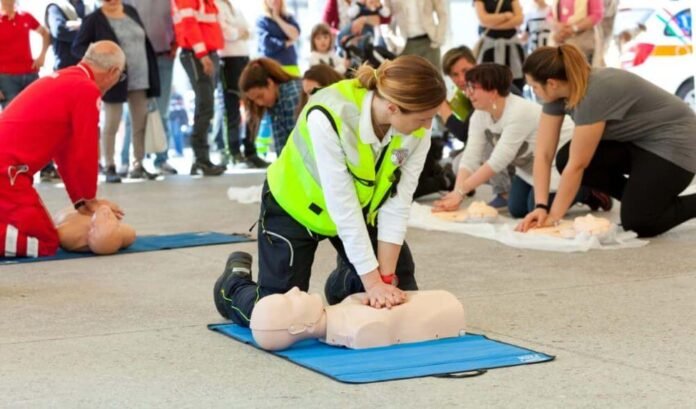
The certification is delivered through a blended learning model: theory is completed online at the employee’s own pace, and the hands-on skills are assessed in a single in-person day. The practical component is where most of the real value is built — compression technique, AED confidence, and staying calm under a simulated emergency are things that can’t be absorbed through reading alone.
Certifications are valid for three years. After that, a renewal course is required to maintain compliance.
Building a First Aid Program That Doesn’t Lapse
The problem most businesses run into isn’t getting certified the first time. It’s maintaining coverage as the workforce changes. An employee who completed their certification two years ago has one year left. The person who was trained when you opened has since left. The backup you designated last spring is now on a different shift.
A functioning workplace first aid program treats certification the same way it treats any other recurring operational task: scheduled, tracked, and assigned. A simple approach is to maintain a spreadsheet with the certification expiry date for every trained employee, set a reminder 90 days before each expiry, and identify a secondary employee to certify alongside your primary so you always have backup coverage.
For businesses with higher turnover — retail, hospitality, food service — building a first aid refresher into your annual operations calendar is more efficient than scrambling to recertify after a gap appears.
Coast2Coast First Aid & Aquatics offers group and individual certification options with scheduling flexibility built in. Blended learning means the theory portion doesn’t pull employees off the floor during business hours.
The Business Case Beyond Compliance
Framing workplace first aid purely as a compliance exercise undersells it. There’s a straightforward operational argument for having trained employees that has nothing to do with WorkplaceNL audits.
Businesses that can demonstrate active first aid coverage tend to perform better on insurance assessments. Employees who are trained are more confident, not just in medical emergencies but in crisis response generally — it’s a signal that the organization takes safety seriously. And in a tight labour market, workplace culture markers like genuine safety investment are noticed by the people you’re trying to retain.
The regulatory floor is the minimum. Most employers who think through the actual value of certification — for their staff, their culture, and their liability position — find there’s a strong case for going beyond it.
The Practical Summary
Workplace first aid compliance in Newfoundland is not a grey area. The NL OHS Act is clear, WorkplaceNL enforces it, and the gap between what most small businesses have in place and what the regulation requires is often larger than owners realize. The good news is that closing that gap is genuinely straightforward — a day of in-person training, a properly stocked kit, and a calendar reminder set three years out.
The businesses that handle this well are not doing anything complicated. They’re just doing it on a schedule, before an incident makes it urgent.
If you are looking for first aid and CPR training near Water Street, the downtown St. John’s area, or surrounding neighbourhoods in the Avalon Peninsula region, you may reach out to Coast2Coast First Aid & Aquatics serving the St. John’s area.
FAQS
Q: What does WorkplaceNL require for workplace first aid in Newfoundland and Labrador? A: Under the NL Occupational Health and Safety Act, employers must provide first aid appropriate to the size and hazard level of their workplace. This includes having a minimum number of trained first aid providers available during working hours, maintaining a stocked first aid kit, and ensuring workers know how to access first aid. The specific requirements vary by workplace classification, but most St. John’s employers need at least one Standard First Aid certified employee per shift.
Q: How is Standard First Aid different from a basic CPR course? A: A basic CPR course typically covers cardiac arrest response and AED use for adults, and sometimes children and infants. Standard First Aid is a broader certification that includes CPR/AED plus a full range of emergency response skills: choking management, severe bleeding control, allergic reaction response, fracture and injury stabilization, and basic medical emergency assessment. Standard First Aid and CPR/AED Level C is the certification required for most workplace compliance purposes under the NL OHS Act.
Q: How long does a Standard First Aid and CPR/AED certification last in Newfoundland? A: Certifications are valid for three years from the date of issue. After that, a recertification course is required to maintain compliance with WorkplaceNL requirements. Employers should track expiry dates for all certified staff and ensure that trained coverage is maintained continuously — particularly after turnover, which is one of the most common reasons compliance lapses.
Q: Can a small business in St. John’s with only two or three employees skip first aid training? A: No. The NL OHS Act applies to employers regardless of business size. While the specific requirements scale with workforce size and hazard classification, even small employers have obligations to provide first aid access for their workers. A low-hazard, two-person operation may have simpler requirements than a large industrial site, but the obligation to have trained first aid coverage and a properly stocked kit remains.
Q: Does blended learning CPR and first aid certification count for WorkplaceNL compliance? A: Yes, provided the course is delivered by a recognized certifying body and the hands-on skills component is completed in person with a qualified instructor. The online theory portion can be completed remotely at the employee’s own pace, but the practical assessment — which covers compression technique, AED operation, and scenario-based response — must be conducted in a supervised, in-person setting to satisfy regulatory requirements.