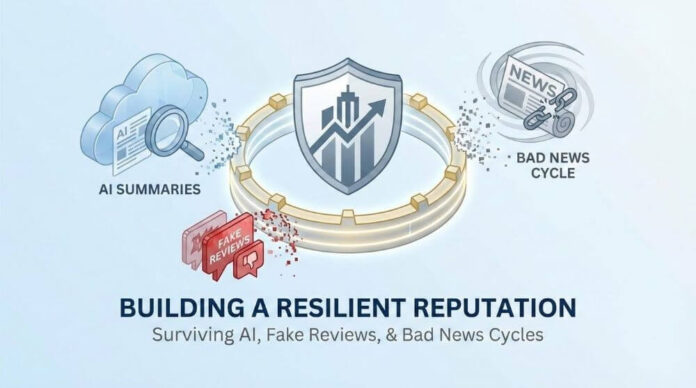

Building a business reputation used to mean managing what people said about you. Now it means managing what AI systems say about you, what competitors are fabricating about you, and how quickly bad news can compound before you have a chance to respond.
These three threats operate simultaneously and reinforce each other. A fake review campaign generates the negative content that AI Overviews pull from. A bad-news cycle produces snippets that linger in search results for months. Understanding each one separately is the starting point for building a reputation that holds up against all three.
The Three Threats You Are Actually Dealing With
AI Summaries and Distorted Narratives
Google’s AI Overviews and tools like Perplexity pull from whatever sources they deem relevant, and they weight recency and engagement alongside authority. That means a viral negative review, a poorly sourced complaint thread, or an AI-generated hallucination can surface in a summary about your business before any authoritative content you have published.
Three specific failure modes appear regularly. AI Overviews can surface fake review snippets, showing a restaurant with a 1.2-star rating pulled from fabricated feedback. Perplexity can lead to false competitor claims through hallucinations, resulting in confident-sounding statements about your business that lack any basis in fact. Bing Chat can amplify unverified social media posts, treating a viral complaint as a representative data point.
The countermeasure is a structured authority. Schema markup in JSON-LD, a verified Google Knowledge Graph entry, and consistent E-E-A-T signals give AI systems accurate, structured information to pull from. When authoritative structured content exists, it competes with and often displaces distorted content in AI outputs.
Fake Reviews from Competitors
Review manipulation is more common and more sophisticated than most businesses realize. The tactics include review bombing with coordinated waves of one-star posts, astroturfing through cheap outsourced review gigs, sock puppet accounts operated by competitors, and increasingly, AI-generated review farms that produce bulk fake feedback at scale.
Detection tools exist and work reasonably well. Fakespot identifies approximately 85% of fake reviews on Google and Yelp. ReviewMeta operates at around 92 percent accuracy. Originality.ai identifies AI-generated review content at 97 percent accuracy. Using these tools in combination covers the vast majority of manipulation attempts before they compound.
The removal process requires documentation. Screenshot the reviews, flag them through the Google My Business dashboard, submit Google’s removal form with specific policy violation citations, and follow up. One HVAC company documented and removed 187 fake reviews through this process, thereby improving their overall rating by more than 2 stars.
The Bad News Cycle
Negative stories generate roughly six times more engagement than positive ones on social media. They surface faster in search results, they linger longer, and they get amplified by AI systems that weigh engagement signals. The cycle follows a predictable pattern.
The first 24 hours are the ignition phase. This is when monitoring matters most. By 48 to 72 hours, the story has reached peak amplification, and the damage is largely set. Resolution extends into week two and beyond, but the window for containing the narrative is narrow.
The companies that come through bad news cycles intact are the ones with a response in the first hour, not the first day.
Building the Authentic Foundation
Reactive reputation management, responding to problems after they surface, costs significantly more time and money than proactive foundation-building. Google’s E-E-A-T framework now directly governs how AI systems evaluate and summarize business content. Companies with documented, verifiable proof points achieve better AI outputs than those without them.
A 12-Month Proof Point Calendar
A structured approach to building verifiable credentials looks like this:
- Q1: BBB A+ accreditation and Google Business Profile verification with complete photo coverage
- Q2: Industry award submissions and Clutch verified review campaign
- Q3: Case studies with named clients, specific metrics, and recent dates
- Q4: Executive bylines in credible publications and HARO response campaign
Each of these creates a permanent, indexed asset that AI systems can draw from when generating summaries about your business. The goal is not to flood the internet with content. It is to ensure that when AI systems look for authoritative information about your company, they find structured, verified, context-rich material rather than whatever happens to have the most engagement.
A practical display format for review proof across your site: “As seen in Forbes, Clutch Top 100, 4.9 stars across 1,247 verified reviews.” This kind of condensed credibility signal reinforces trust for both human visitors and AI parsing systems.
Proactive Review Management
Waiting for customers to leave reviews on their own produces a skewed sample. Dissatisfied customers are more motivated to write reviews than satisfied ones. The result is a review profile that underrepresents your actual performance.
Getting Genuine Reviews at Volume
Text-based review requests convert at roughly 42 percent, compared to 8 percent for email links. A seven-channel feedback system covers the main opportunities:
- Podium SMS automation sends review requests immediately after service completion
- QR codes on receipts and invoices linking directly to your Google review page
- Post-service NPS surveys that route high scorers to public review platforms
- Employee advocacy encourages staff to mention reviews in closing conversations
- Follow-up sequences for repeat customers who have not yet left a review
The review gate approach, directing five-star responses to public platforms and routing lower scores to private feedback, is effective for managing quality without violating platform terms. The distinction that matters: you can ask customers to share their experience and make it easy for satisfied customers to do so. You cannot offer incentives tied to positive ratings.
Detecting and Removing Fake Reviews
When fake reviews appear, the response protocol is:
- Screenshot and document with timestamps before anything is removed
- Run the review through Fakespot or ReviewMeta to establish the detection basis
- Flag through your Google My Business or Yelp dashboard with specific policy citations
- Submit the platform’s formal removal form
- Send a cease and desist letter through legal counsel if a coordinated campaign is identifiable
- Follow up on the removal request every five to seven business days
Removal is not guaranteed, but documentation of the attempt matters. Platforms take repeated flagging seriously, and the paper trail is useful if the situation escalates.
Content That Holds Up Against AI Distortion
Thin content is vulnerable to AI summarization errors. A 400-word page with generic claims gives AI systems very little accurate material to draw from and very little to compete with when distorted content appears.
Context-rich, multimedia assets resist distortion because they give AI systems depth to work with. The structural requirements that matter most:
- Minimum 2,000 words with original data, named sources, and specific claims
- Embedded video with schema markup using VideoObject type
- FAQ sections structured with the FAQPage schema
- Author attribution with Person schema markup for executive bylines
- Primary source citations that can be verified independently
NetReputation’s content work reflects this directly: long-form, entity-rich content with structured markup consistently outperforms thin content in both traditional search and AI citation rates, because AI systems have more accurate material to draw from.
The 24-Asset Cornerstone Framework
Building genuine content authority requires sustained output, not a single effort. A practical 12-month target:
- 12 industry reports or definitive guides with original data
- 6 founder or executive interview features, transcribed for indexing
- 3 video case studies with named clients and measurable outcomes
- 3 expert roundups featuring verifiable third-party contributors
Distribute through HARO queries for earned media placement, LinkedIn for professional audience reach, and Reddit AMAs where your industry has an active community. Each distribution channel creates additional citation pathways that AI systems can draw from.
The Crisis Playbook
Response time is the variable with the highest impact on crisis outcomes. Companies that respond within one hour of a crisis breaking consistently experience significantly less reputational damage than companies that wait. The four-hour response structure:
Hour one: Post an acknowledgment, specifically “We are aware of this and actively investigating,” on the channels where the story is spreading. Activate an internal response channel. Do not wait for all the facts before acknowledging.
Hour two: Gather documentation internally. Use AI detection tools to assess whether fake reviews or coordinated activity is involved. Prepare a holding statement that is specific enough to be credible without admitting fault prematurely.
Hour three: Identify concrete resolution steps. Offer direct remediation to affected customers. Concrete action, refunds, direct contact, service recovery, communicates accountability more effectively than any statement.
Hour four: Amplify three or more positive stories through owned channels. Employee advocacy, satisfied customer testimonials, and positive media coverage all help shift the sentiment balance as the initial story begins to lose momentum.
Template language that works: “We sincerely apologize for the experience [customer name] describes and are reaching out directly to make it right. This does not reflect our standard, and we are taking steps to ensure it does not happen again.”
Escalation level matters too. A review bombing campaign is directed to a VP-level decision-maker. An executive scandal goes directly to the CEO. Routing the wrong severity to the wrong level delays response and compounds damage.
The businesses that build this infrastructure before they need it are the ones that come through bad news cycles with their reputation intact. The ones that build it in response to a crisis are managing damage that proper monitoring would have caught earlier.
Build the foundation before the threat appears. The cost of proactive reputation management is a fraction of what reactive repair costs, and the outcomes are reliably better.