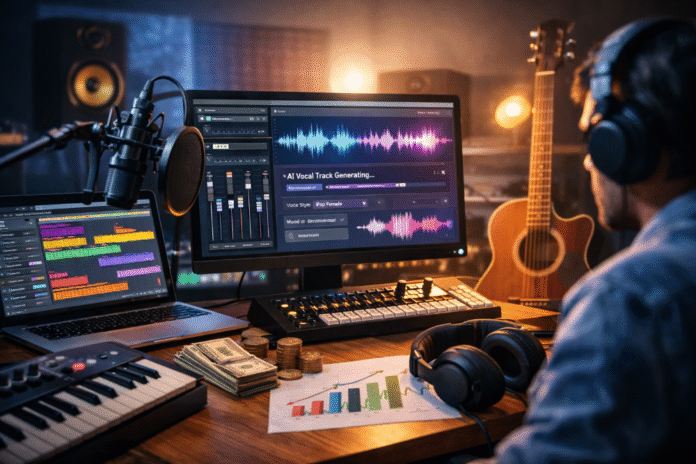

The creator economy is projected to approach 480 billion dollars by 2027, according to Goldman Sachs. Musicians, filmmakers, podcasters, and course creators are building scalable digital brands, yet production costs remain one of their biggest investment bottlenecks. Studio sessions, professional voice talent, and custom music composition can quickly reduce margins.
As investors evaluate creator-led ventures, they increasingly ask a practical question: can high-quality audio and music production scale without proportional cost growth? MiniMax AI introduces a new layer of efficiency by transforming text into studio-quality voiceovers, speeches, and music tracks with vocals and instruments. Understanding its impact helps both creators and investors make informed capital decisions.
What Is the Direct Investment Impact of MiniMax AI?
MiniMax AI changes the economics of audio production by lowering variable costs and accelerating output. Instead of relying entirely on booked studio time, creators can convert scripts into expressive narration or fully developed music tracks within a digital workflow.
For investors, this shift improves three measurable indicators:
- Cost per piece of produced content
- Time required to launch new campaigns or releases
- Scalability of intellectual property libraries
By compressing production timelines and enabling experimentation with tone, emotion, and instrumentation, MiniMax AI allows creators to test more ideas while maintaining budget discipline. This alignment between creative flexibility and capital efficiency is increasingly relevant in valuation discussions.
How Does MiniMax AI Reshape Audio Production Models?
How are traditional costs structured?
Professional studio rates can range from 100 to 500 dollars per hour, depending on geography and expertise. Hiring voice artists or session musicians adds recurring expense. For weekly podcast producers or independent music artists, these costs compound quickly.
MiniMax AI enables text to be transformed into:
- Emotional voiceovers for storytelling
- Structured speeches for courses or presentations
- Music tracks with vocal layers and instrumental backing
- Demo compositions for early-stage pitching
This reduces dependency on fixed cost structures while preserving creative control.
How does this improve scalability?
Scalability is not only about audience growth. It is about producing more assets without increasing overhead at the same pace. When scripts convert directly into audio outputs, creators can expand libraries faster, which strengthens long-term revenue potential through licensing and streaming.
Why Is MiniMax AI Relevant to Platform-Based Creators?
Modern creators operate across multiple platforms, including streaming services, social channels, and online education marketplaces. Integrated tools play a central role in managing this complexity.
In the ever-evolving creator workflows, MiniMax AI is available through invideo and fits into broader digital production stacks. Many creators who already rely on an AI video app for visual storytelling now extend that environment to audio using MiniMax AI, allowing scripts to become both visual and sonic assets within a unified system.
This convergence improves:
- Workflow continuity
- Brand voice consistency
- Speed of cross-format publishing
When production tools align inside a connected ecosystem, investors see lower operational friction and more predictable scaling models.
How Does MiniMax AI Influence Creator Valuation Metrics?
How do investors measure creative businesses?
Valuation models increasingly include:
- Revenue per content asset
- Engagement rates across formats
- Lifetime value of subscribers
- Production efficiency ratios
MiniMax AI affects the last metric directly. Lower production costs combined with consistent output can improve margin structures over time.
According to Statista, global music streaming revenue surpassed 40 billion dollars in 2023. As distribution grows, the competitive advantage shifts toward creators who can supply high-quality content consistently. Efficient production, therefore, becomes an investment differentiator.
Does IP ownership play a role?
Yes. When creators generate their own voiceovers and compositions internally, they retain greater control over licensing, distribution, and monetization. Retained intellectual property enhances long-term enterprise value and supports diversified revenue streams such as:
- Course resales
- Podcast syndication
- Film soundtrack licensing
- Branded collaborations
Can MiniMax AI Expand Revenue Opportunities?
Revenue expansion depends on both output volume and quality. By transforming text prompts into nuanced vocal and music outputs, MiniMax AI helps creators launch new formats with reduced lead time.
Examples include:
- Premium audio storytelling subscriptions
- Multi-language course narration
- Fast concept demos for label pitches
- Background music libraries for digital products
Faster experimentation leads to quicker market validation. Investors typically favor ventures that can test and iterate without committing extensive upfront capital.
Is There Broader Evidence Supporting AI-Driven Creator Growth?
Over 50 million people worldwide now identify as content creators in some capacity. Short-form video, podcasting, digital courses, and independent music releases continue to expand globally.
AI-driven production tools align with three observable patterns:
- Shorter production cycles
- Higher publishing frequency
- Cross-platform monetization
MiniMax AI supports these patterns by enabling rapid conversion of written ideas into emotionally expressive sound experiences. This efficiency supports sustainable growth models rather than one-time viral spikes.
Frequently Asked Questions
What is MiniMax AI used for in audio creation?
MiniMax AI converts text into studio-quality voiceovers, speeches, and music tracks with layered vocals and instruments. Creators use it to produce demos, narration, podcasts, and thematic compositions without relying exclusively on external recording sessions.
Can AI-generated audio be commercially viable?
Commercial viability depends on licensing terms and distribution channels. Many creators use AI-generated narration and music in podcasts, online courses, and branded content where ownership clarity and scalability are central considerations.
Does adopting AI reduce creative authenticity?
AI tools support idea generation and production speed, but creative direction remains human-driven. Musicians and storytellers still shape themes, scripts, and emotional tone, using technology to execute at scale.
How does this affect investor confidence?
Investors prioritize cost efficiency, growth rate, and recurring revenue. When production becomes faster and more predictable, financial modeling improves, which can strengthen confidence in long-term returns.
Is technical expertise required to use such tools?
Most AI-driven audio systems are designed for intuitive use. Script input, tone selection, and instrument preferences are typically managed through straightforward interfaces, enabling creators to focus on storytelling and composition.
Conclusion
The expansion of the creator economy demands scalable infrastructure behind the scenes. MiniMax AI offers a pathway for turning written ideas into studio-quality audio and music assets that support recurring revenue and diversified monetization.
For musicians, filmmakers, course creators, and storytellers, the technology introduces flexibility without sacrificing control. For investors, it improves production efficiency, strengthens intellectual property portfolios, and enhances valuation models. As digital media continues evolving, MiniMax AI represents a structural shift in how creative capital is deployed and scaled.